

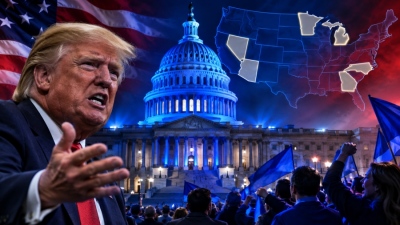
In a thriller electoral contest capable of completely upending political dynamics in Washington and determining the remainder of Donald Trump's presidential term at a time when conflict fronts in the Persian Gulf with Iran and in Ukraine dominate, American voters head to the polls today, Tuesday, November 3, to renew all 435 seats of the House of Representatives and 35 out of the 100 total seats in the Senate. Latest polls record a clear Democratic lead nationwide, while electoral projections capture the prospect of a majority shift in both chambers of Congress, where Republicans currently maintain a slim majority. However, the final balance of power, particularly in the Senate, will be decided across a series of toss-up contests where even a few thousand votes could prove decisive for the final outcome, impacting US midterm elections.
Democrats take the House with 241 seats
In the House of Representatives (currently controlled by Republicans with 219 seats against 214 for Democrats), Democrats register a lead ranging from 4 to 15 percentage points in the latest major nationwide measurements. RealClearPolling's poll average places Democrats at 52% versus 43.1% for Republicans, reflecting a difference of nearly nine points. Electoral projections translate this picture into a significant potential shift in parliamentary correlations. Decision Desk HQ's model estimates Democrats could secure 241 of the House's 435 seats, leaving 194 to Republicans. Other models display varying estimates, with projections for Democrats ranging roughly from 236 to 253 seats, reshaping Congressional power balances.
Democratic lead by poll
Percentage points, based on the latest nationwide measurements
Senate thriller — Democrats at 52 seats
The electoral puzzle in the Senate proves even more complex. Republicans currently hold 53 seats against 47 for Democrats, alongside two independents. To secure a 51-seat majority, Democrats require a net gain of four seats. Decision Desk HQ projects a composition of 52 seats for the Democratic caucus and 48 for Republicans. Nevertheless, individual estimates diverge noticeably, with certain models capturing an almost absolute balance of power, defining Senate majority projections.
The 6 critical states
The epicenter of the electoral thriller lies in six states: Iowa, Alaska, Kansas, Texas, Ohio, and Maine. In all six, Republicans defend their seats, while latest poll averages place Democrats ahead by narrow margins. In Iowa the gap narrows to 0.7 percentage points, in Alaska to 2.4, and in Kansas to 3.1. Correspondingly, in Texas Democrats record a 3.3-point lead, in Ohio 3.6, and in Maine four points. These represent contests where polling margin of error and voter turnout can decisively influence the outcome. Toss-up battles unfold for the House as well, with districts in Florida, Texas, Iowa, Pennsylvania, and Ohio gathering intense interest, impacting battleground state polls.
 Trump: We will do well, polls are rigged
In one of his final campaign appearances, US President Donald Trump appeared optimistic regarding Republican performance despite polls assigning both the House of Representatives and the Senate to Democrats. Having held 26 campaign rallies over a span of one month, Trump argued Republicans will perform well, underlining that polls are rigged. "I believe we will do quite well. I infer this from our rallies, which are as large as they have ever been," Trump stated, pointing out that "if we lose to the Democrats, this country is finished." "If we lose the House of Representatives, the Senate, and the presidency, our country is finished. Because you are dealing with crazy people," Trump emphasized, warning that if he loses control of Congress, he will utilize presidential executive orders and primarily the right of veto, shaping Trump campaign rhetoric.
The first Muslim in the Senate
Beyond seat distribution, particular interest attaches to the state of Michigan, where Democratic candidate, physician, and former public health official Abdul El-Sayed aims to become the first Muslim elected to the Senate, facing Republican Mike Rogers. Their toss-up contest for a Senate seat intensified further over the weekend when US Representative Haley Stevens—who lost to El-Sayed in the Democratic primaries—shifted stance and announced her endorsement of Rogers. Subsequently, El-Sayed's campaign announced it raised $2.4 million on Sunday, recording its largest single-day fundraising amount, largely thanks to small donations. El-Sayed, a Muslim of Egyptian descent born in Michigan, has been targeted by Trump and other Republicans, who questioned his allegiance to the US and characterized him, without evidence, as a terrorism supporter. El-Sayed termed questioning his allegiance to the United States "disgraceful," defining Michigan Senate candidates.
California in the spotlight
California also entered the spotlight following the Supreme Court's swift rejection of the Trump administration's Department of Justice attempt to intervene and block the counting of votes allegedly originating from individuals lacking US citizenship. The high court's decision was issued with notable speed. California had argued the federal lawsuit would strip voting rights from 20,000 voters based on vague allegations and that the process of identifying individuals without US citizenship proved prone to errors, altering voter eligibility rulings.
57 million Americans have already voted
Early voting, whether in person or via mail-in ballot, already recorded records, as 57 million citizens had voted by Monday afternoon, November 2, compared to 45 million across the entire 2022 midterm election period, according to the University of Florida's Election Lab, driving early voting records.
What do the elections concern?
House of Representatives: All 435 members are elected for a two-year term.
Senate: 35 out of 100 senators (Class 2 seats) are elected for a six-year term.
Governors: Gubernatorial elections take place across 39 states and territories, outlining midterm election structures.
Republicans will lose by 5% to 6%
Most Americans remain certain Trump will not accept election results if Republicans lose control of Congress. He already claims Democrats attempt to steal his party's victory, shaping election integrity debates.
At stake in the Senate
Out of 100 Senate seats available for 2026, 35 are up for grabs. According to projections by analysis platform Real Clear Politics (RCP), Democrats could win a total of 47 seats, while Republicans could win 44. In 10 states, candidate odds run roughly tied; in 8, Republicans hold a slight advantage; and a win in 6 states would suffice to secure half the seats in the upper house of Congress. Vice President Vance would also secure remaining tie-breaking votes. Russia's Dubravsky Consulting calculated Republicans will lose the House of Representatives, yet considers the US Senate up for grabs. In the House, Democrats will win 228 seats against 207 for Republicans, and will likewise win 51 against 49 in the Senate. Nevertheless, the most probable scenario entails Republicans retaining Senate control due to Vance, influencing Senate control projections.
The House is lost for Republicans — Democrats will win up to 237 seats
Meanwhile, the position of Republicans in the House of Representatives appears nearly hopeless. According to Real Clear Politics estimates, Democrats will win 227 out of 435 seats. And the closer election day approaches, the weaker the Republican position grows. According to the Cook Political Report, Democrats possess the opportunity to win 230 up to 237 seats in the House of Representatives. In the Senate, conversely, Republicans could hold a one- or two-seat advantage. However, pollsters warn recent polls show Trump supporters weakening in traditionally conservative states like South Carolina and Mississippi, meaning surprises could emerge there as well. A Democrat could also win the election in Alaska for the first time in 18 years, defining House seat projections.
95% probability of Democratic victory in the House and 76.4% in the Senate
Concurrently, a poll by the New York Times and Siena College showed 52% of Americans trust the Democratic Party, while 41% trust the Republican Party. According to CNN, Democratic popularity hovers around 49%, while Republicans stand at 39%. Renowned election analyst Nate Silver believes Democrats hold a 95% chance of winning the House of Representatives and a 76.4% chance of winning the Senate. Decision Desk HQ estimates the probability of a Democratic majority in the House at 77% and in the Senate at 56%, shaping polling analytics.
Trump's approval has dropped and $5,000 to every adult plus $500 from Obamacare
According to American sociologists, poor Republican performance links to declining Trump approval ratings. Per various polls, 31–32% of Americans trusted him in late October. Nonetheless, US leader Trump attempts to help his party. Specifically, he promised ordinary citizens cash payments if his party's members maintain control of Congress. "If Republicans win a majority in the US House of Representatives and Senate, then in both cases, thanks to our enormous power and economic success, I will disburse a $5,000 dividend to every adult US citizen," Trump stated. Furthermore, since late September, the Treasury Department has been mailing letters to Obamacare enrollees containing $500 checks and a letter signed by the president listing his achievements. And in early October, the American leader promised to pay all retirees $90 from the Medicare Improvement Fund. However, Democrats consider this latest initiative illegal, as it occurred without congressional approval. Should financial aid to ordinary citizens, which critics term voter buying, fail to bring victory to the Republican Party, Trump may simply refuse to accept House election results. He already accuses pollsters of lying and Democratic officials in certain states of inflating voter registration figures. He claims millions of forged ballots could exist, driving campaign financial promises.
Will pay $1 million… to anyone providing evidence
The president claims willingness to pay $1 million to anyone reporting fraud in upcoming or previous elections, provided information leads to the conviction of those responsible. Meanwhile, MAGA opinion leaders continuously publish social media messages claiming Democrats can win only through mass electoral fraud. The Washington Post does not rule out that Trump is thus preparing Americans for a disruption of the electoral process. Meanwhile, a poll by The Post, ABC News, and Ipsos found only 28% of Americans feel confident the president will accept election results if Republicans lose, highlighting election integrity concerns.
Trump will not challenge the electoral process as a whole
Trump is unlikely to challenge the entire electoral process because it proves technically difficult to execute and serves no purpose. Elections will not be supervised by the federal government but by state authorities, and across many regions, Republicans will prevail—a victory that must not be contested. Moreover, Trump has already seemingly accepted losing control of the House of Representatives, shaping legal challenge strategies.
The Senate is Trump's target
The main issue revolves around Senate elections. Democrats and Republicans can secure only majorities of one or two seats. Therefore, when Trump speaks of fraud, he likely targets the Senate. Yet even here, he will challenge elections not across the entire United States, but in specific states. For instance, Alaska, Texas, and other traditionally Republican areas find themselves in difficult positions this time. Another issue is that Trump lacks many options. For example, even Republicans would not approve the president attempting to forcefully intervene in the electoral process: they worry that one day the United States might be led by someone from the left. Meanwhile, the Supreme Court—which includes Trump's appointees—does not always issue the decisions he desires. As known, Trump's refusal to concede his defeat in the 2008—rather 2020—presidential election led his supporters to attempt occupying the Capitol building. The riots resulted in five deaths and hundreds of injuries. "The storming of the Capitol is a dark affair in which someone clearly had a vested interest. Otherwise, the crowd could not have broken through. Trump finds himself in a completely different situation today. He may not recognize House election results, but this is unlikely to have any effect. The conflict between the president and Democrats has already reached a level where any cooperation is out of the question," defining Senate battleground focus.
Massive political crisis in the US
Consequently, the domestic political crisis will continue escalating, and none of the participants will want to assume responsibility. The US president and Democratic members of Congress may attempt to shift public attention from domestic issues to external flashpoints. For example, Trump will repeat attacks against Iran, and his Democratic opponents will begin supporting Ukraine. Then, the American political crisis will become a threat to the entire international community. Difficult days lie ahead internationally, cementing global geopolitical risks.
www.bankingnews.gr












Σχόλια αναγνωστών